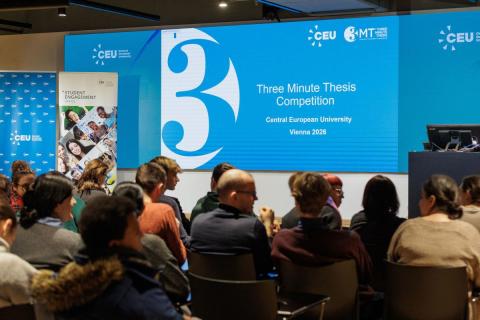
The CEU Three Minute Thesis (3MT®) 2026 Final celebrated the diversity, depth, and societal relevance of doctoral research at Central European University. In just three minutes each, 11 PhD candidates presented their research to a broad audience, demonstrating how complex ideas can be communicated with clarity and impact.
This year’s finalists represented eight academic departments across CEU, including Cognitive Science, Philosophy, Environmental Sciences and Policy, Legal Studies, Network and Data Science, Sociology and Social Anthropology, and the Doctoral School of Political Science, Public Policy, and International Relations.
The presentations showed how CEU doctoral research engages with some of today’s most urgent and fascinating questions: how emotions shape the way we learn from others; how societies move from conflict toward peace; how media language influences what people come to accept as normal in politics; and how corruption networks respond to transparency rules. Other talks explored why some societies resist far-right politics, how ideas of success are used by authoritarian states, how racial and gender hierarchies are reproduced, and how rivers, cities, and security systems are governed in practice. The program also included philosophical reflections on what we take for granted as “certain” and how meaning itself is formed. Together, the talks offered a compelling glimpse into research that helps us better understand the world—and question how it is shaped.
Following deliberation by the jury and audience voting, the CEU 3MT® 2026 awards were announced:
Jury Prize Winner
Petra Radic
Doctoral School of Political Science, Public Policy, and International Relations
Thesis title: Deception by Design: Propaganda as the Interplay of Media Frames, Issue Attitudes, and Legislative Change
Supervisor: Alexander Bor and Melis Laebens
“My dissertation studies how people are gradually led to accept or tolerate political change by accepting narratives that justify it. I focus on countries where democracy is quietly weakening and look at how media language persuades people or makes them passive. I analyze real news content to see which words, phrases, and repeated messages are used most, and then use these same linguistic patterns to design experiments and test which linguistic combinations perform best at triggering emotions, shaping attitudes, and making people more accepting of democratic backsliding.”
Jury Runner-Up
Irene Tello Arista
Doctoral School of Political Science, Public Policy, and International Relations
Thesis title: Using Beneficial Ownership Data for Anti-Corruption Efforts: Benefits, Risks, and New Approaches
Supervisor: Mihály Fazekas
“An array of legal entities, like companies and trusts, are currently being used all over the world to launder the ill-gotten wealth of corruption networks and criminal organizations, as well as for other financial crimes. To prevent this from happening, beneficial ownership registers have been created in over 100 countries to have access to the real persons who benefit from these legal arrangements. Nonetheless, the impact that this anti-money laundering policy has, either positive or negative, as well as the adaptation strategies of corruption networks to comply with these transparency regulations, has been understudied in the academic literature. This dissertation offers an approximation to the problem of money laundering and the corrupting impacts of political connections, through conducting interviews, large-scale beneficial ownership data analysis, and machine learning methods to identify the troubles that arise in tracking these two issues in the absence of data, both for individual investigations and on a systemic level.”
Researcher profile
Popular Choice Award
Piero Birello, Network and Data Science
Thesis title: From Urban Structure to Human Dynamics: Effects of Proximity-Based Urban Planning
Supervisor: Marton Karsai
This thesis investigates the effects of proximity-based urban planning—particularly the 15-minute city concept—on human mobility within cities. It examines whether the spatial distribution of amenities and specific urban and transport interventions shape mobility patterns across different neighborhoods. It also explores how these characteristics and interventions influence population mixing, with particular attention to emerging socio-economic segregation dynamics.
Researcher profile
The 3MT® competition reflects CEU’s commitment to transforming knowledge into action by supporting doctoral researchers in communicating their work beyond academia.
Save the date for the next academic year’s 3MT Final that will celebrate research excellence and intellectual diversity across the university on 21 January 2027.